

Ghana Export-Import Bank (GEXIM) has officially joined the United Nations Global Compact (UNGC), becoming part of the world’s largest corporate sustainability initiative and reaffirming its commitment to responsible, ethical and sustainable banking.
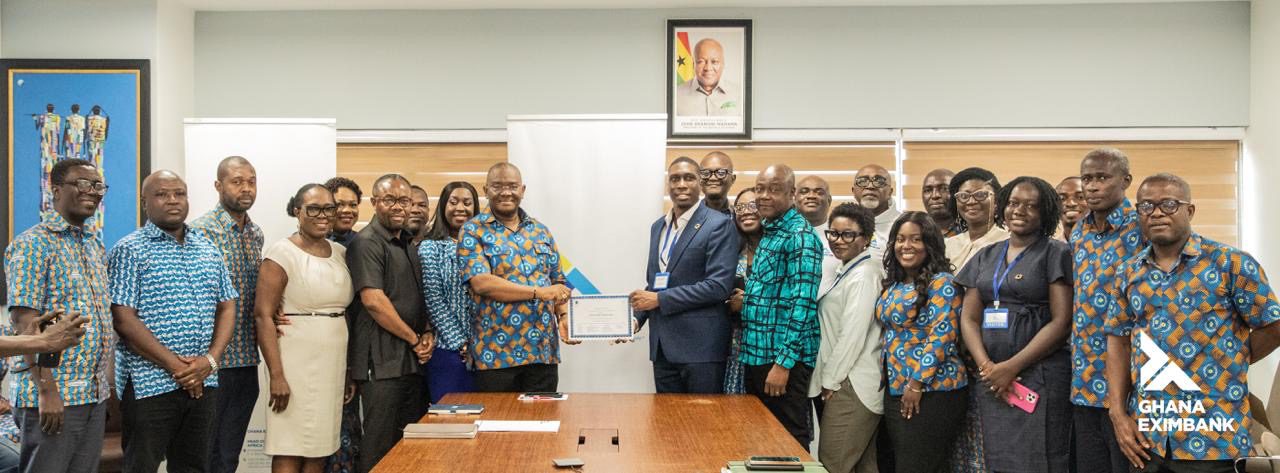
The landmark partnership, formalized during a signing ceremony held at the Bank’s headquarters in Accra on Thursday, July 2, 2026, marks one of the most significant governance and sustainability milestones in GEXIM’s institutional journey. By joining the UN Global Compact, the Bank commits to integrating the Compact’s Ten Principles on human rights, labour, environment and anti-corruption into its strategy, operations and organizational culture, while strengthening transparency and accountability through annual sustainability reporting.
Speaking at the ceremony, the Chief Executive of Ghana EXIM Bank, Hon. Sylvester Adinam Mensah, described the occasion as a defining moment in the Bank’s evolution into a globally responsible development finance institution.
“By embracing these principles, we reaffirm our commitment to conducting business in a responsible, ethical and sustainable manner. This signals our intent to move beyond ambition into action, ensuring that sustainability is not an isolated initiative, but a core part of our operations,” Hon. Mensah stated.
He emphasized that joining the United Nations Global Compact is more than an institutional endorsement; it represents a long-term commitment to embedding sustainability into the Bank’s governance, financing decisions and stakeholder engagement.

Building on a Strong Sustainability Foundation
The Chief Executive traced the Bank’s sustainability journey to early 2025, when GEXIM formulated its Environmental, Social and Governance (ESG) and Sustainability Policy and established the Sustainability and Strategic Impact Department (SSID) to mainstream responsible finance across the institution.
According to him, these reforms were designed to strengthen sustainable finance practices, improve impact measurement, embed ESG considerations into lending decisions and ensure that the Bank’s interventions continue to generate measurable economic, social and environmental value.
He described the Bank’s membership of the UN Global Compact as the natural progression of these efforts.
“Our membership connects Ghana EXIM Bank to a global network of responsible institutions committed to advancing sustainable development. It provides an opportunity to continuously improve how we operate, measure our impact and contribute meaningfully to national and global development priorities,” he noted.
Strengthening Responsible Export Finance
Hon. Mensah explained that for a development finance institution whose mandate is to support Ghana’s export-led industrialization, the significance of joining the Compact is practical rather than symbolic.
The UN Global Compact’s internationally recognized framework, he said, reinforces the standards the Bank applies in financing exporters, manufacturers, agribusinesses and other productive sectors while ensuring that growth remains inclusive, ethical and environmentally sustainable.
He further disclosed that the Bank has already begun measuring and reporting the impact of its financing activities on Ghanaian society and, through its membership of the Compact, will continue to strengthen transparency by communicating its sustainability progress to stakeholders in line with international best practice and the Bank’s enabling legal framework.
Mr Mensah also linked the partnership to Sustainable Development Goal (SDG) 17, which promotes global partnerships for sustainable development.
“This partnership offers us a valuable platform to learn from global best practices, collaborate with like-minded institutions and share our own experiences as we work together to create lasting economic and social impact,” he added.

Strengthening Responsible Export Finance
Hon. Mensah explained that for a development finance institution whose mandate is to support Ghana’s export-led industrialization, the significance of joining the Compact is practical rather than symbolic.
The UN Global Compact’s internationally recognized framework, he said, reinforces the standards the Bank applies in financing exporters, manufacturers, agribusinesses and other productive sectors while ensuring that growth remains inclusive, ethical and environmentally sustainable.
He further disclosed that the Bank has already begun measuring and reporting the impact of its financing activities on Ghanaian society and, through its membership of the Compact, will continue to strengthen transparency by communicating its sustainability progress to stakeholders in line with international best practice and the Bank’s enabling legal framework.
Mr Mensah also linked the partnership to Sustainable Development Goal (SDG) 17, which promotes global partnerships for sustainable development.
“This partnership offers us a valuable platform to learn from global best practices, collaborate with like-minded institutions and share our own experiences as we work together to create lasting economic and social impact,” he added.
A Shared Vision for Sustainable Growth
The signing ceremony was witnessed by members of Executive Management, including Deputy Chief Executive Officer (Banking), Moses Klu Mensah, and Deputy Chief Executive Officer (Finance & Administration), Victor Easmon, representatives of the United Nations Global Compact Ghana, Management and staff of Ghana EXIM Bank.
The partnership between Ghana EXIM Bank and the United Nations Global Compact Ghana represents a shared commitment to advancing responsible banking, sustainable finance and ethical corporate governance. Through this collaboration, the Bank will align its operations with globally recognized sustainability principles while strengthening its contribution to Ghana’s industrialization agenda, export competitiveness and the achievement of the Sustainable Development Goals.
As Ghana EXIM Bank continues to finance businesses that drive value addition, industrial growth and export expansion, its membership of the United Nations Global Compact signals a new chapter in which sustainable development is embedded at the heart of the Bank’s strategy, ensuring that economic progress is matched by social responsibility, environmental stewardship and sound governance.